Cellcycle, part of the SER Group, has formally filed a patent for its proprietary direct recycling process, reinforcing the Group’s position at the forefront of battery recycling innovation.
Developed through the SER Group’s Knowledge Transfer Partnership with Coventry University, alongside ongoing internal research and development, the process enables the efficient recovery of cathode and anode active materials from lithium-ion battery electrodes.
Direct recycling is widely recognised as one of the most promising approaches to achieving a circular battery economy. Unlike conventional recycling routes, it enables the regeneration of cathode and anode materials without breaking them down into their constituent metals, preserving both structure and functionality.
Despite its potential, the technology remains in the early stages of commercialisation, particularly outside of China, where only a limited proportion of global recycling capacity is currently dedicated to direct recycling.
Cellcycle’s newly filed process represents a significant step towards addressing this gap within the UK and European markets, providing a scalable and practical approach to material recovery that aligns with the evolving needs of battery manufacturers and supply chains.
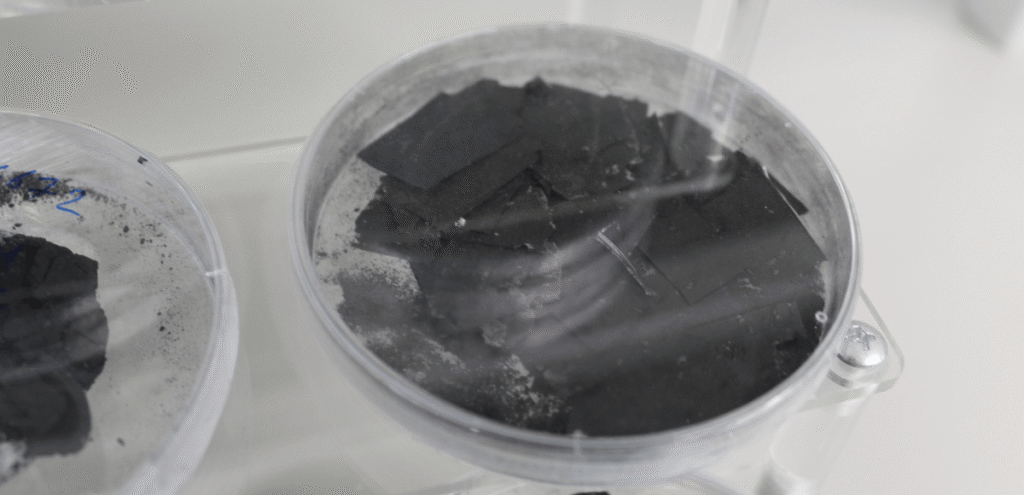
At its core, the process focuses on the controlled removal of binder materials and the selective liberation of active materials from electrode foils. This enables the recovery of graphite and cathode active material in a form that can be directly reused or further processed for relithiation.
Rather than relying on high-energy mechanical processing or aggressive aqueous chemistry, the approach uses a controlled physico-chemical environment to achieve efficient separation of graphite and cathode active materials, preserve lithium within the material structure, reduce contamination from aluminium and copper, minimise dust generation and secondary waste, and enable solvent recovery to support a more circular process.
The result is a cleaner, more selective pathway to recovering high-value battery materials while maintaining their integrity for future use.
A key advantage of Cellcycle’s approach is its ability to operate on real-world industrial feedstocks, having been developed to handle a range of materials including electrode manufacturing scrap from gigafactories, separated electrode foils, pre-processed black mass, and shredded battery fractions.
This makes it particularly well suited to production scrap, where consistent material streams allow for higher recovery efficiency and improved material quality.
As battery manufacturing capacity continues to scale across the UK and Europe, the ability to recover and reuse materials directly from production waste presents a significant opportunity to retain value within domestic supply chains.
The rapid growth of gigafactories across Europe is fundamentally changing the battery supply chain. Alongside increased production capacity comes a parallel increase in manufacturing scrap, much of which remains underutilised or exported for processing.
Cellcycle’s direct recycling process has been developed with this challenge in mind, enabling the recovery of high-purity cathode and anode materials while reducing reliance on imported critical raw materials. In doing so, it offers a significantly lower energy intensity compared to traditional recycling routes and supports seamless integration into closed-loop manufacturing systems.
By enabling materials to be recovered and reintroduced into the supply chain, the process supports a more resilient and sustainable battery ecosystem.
The development of the process has been supported through the SER Group’s Knowledge Transfer Partnership with Coventry University, reflecting a continued commitment to advancing sustainable and scalable battery recycling technologies.
This collaboration has played an important role in accelerating innovation within the business, enabling the transition from concept development through to patent filing and future scale-up.
With the patent now filed, Cellcycle will continue to advance the process through pilot-scale validation and industrial development.
Further technical insights, including process flows and performance data, will be shared in due course as the technology progresses towards commercial deployment.
This milestone marks a significant step in strengthening the UK’s position within the global battery recycling landscape, supporting the development of a more circular, secure, and sustainable supply chain for critical battery materials.