Published: 17 July 2025
A major boost for sustainable battery recycling has arrived with the launch of Project COMET — a three-year initiative to create a circular, UK-based lithium-ion battery supply chain. The project aims to reduce the UK’s reliance on virgin mined materials by recovering critical metals like lithium, cobalt, and nickel from end-of-life EV batteries.
Backed by a total £8.1 million investment, Project COMET is co-funded by the Department for Business and Trade (DBT) through the Advanced Propulsion Centre UK (APC) and by the project partners themselves, each contributing 50% of the total budget.
The project brings together a powerful consortium:
- LiBatt Recycling (a Recyclus Group subsidiary)
- Mint Innovation
- JLR (Jaguar Land Rover)
- WMG at the University of Warwick
Innovative recycling process for UK production
At the heart of Project COMET is Mint Innovation’s low-carbon hydrometallurgical process for refining black mass— the fine powder containing valuable metals extracted from used lithium-ion batteries. Instead of exporting battery waste or relying on imported mined materials, this process will recover metal salts onshore for reuse in battery production.
“We’re thrilled to collaborate with Mint Innovation, JLR, and WMG on this ground-breaking project,” said Robin Brundle, Executive Chairman and Co-Founder of Recyclus Group.
“Securing £4.05 million from the APC shows strong confidence in our vision. Mint’s scalable, low-carbon refining process is what the industry needs to build a true cradle-to-cradle battery economy in the UK.”
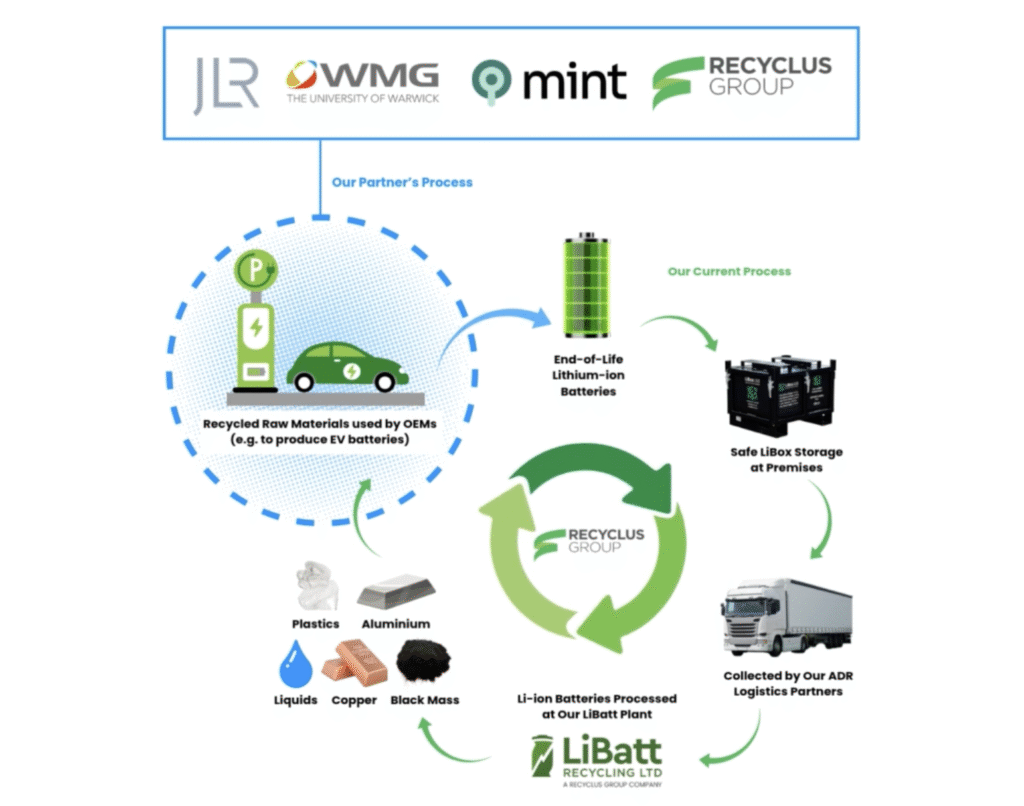
How the circular model works
- JLR will supply end-of-life batteries from its electric vehicles.
- LiBatt Recycling will process these batteries into black mass.
- Mint Innovation will refine the black mass into high-value metal salts at a UK demonstration plant.
- WMG at the University of Warwick will turn these recovered materials into new cathode active materials and battery cells.
- Finally, JLR will test these new materials for real-world EV performance.
This closed-loop approach keeps valuable resources circulating in the UK economy, supporting domestic battery production.
Meeting the UK’s growing battery challenge
The APC estimates that by 2040, the UK will produce around 235 kilotons of EV battery waste. Yet there are currently no industrial-scale recyclers in the country able to produce verified recycled battery materials. Project COMET directly addresses this gap, helping to secure critical raw materials for the next generation of batteries.
The project is based in the West Midlands and is scheduled to complete by 2028. It also supports the UK government’s £2.5 billion DRIVE35 programme, which aims to strengthen the country’s EV manufacturing base and create high-quality green jobs through innovation.
About the partners
Recyclus Group
A UK-based company pioneering sustainable battery recycling infrastructure to support transport electrification and the energy transition. Recyclus focuses on scalable, circular solutions to secure critical materials for the future.
Mint Innovation
A leading cleantech firm using hydrometallurgy and natural biomass to recover valuable metals from electronic and battery waste. Mint launched the world’s first commercial PCB recycling plant in Sydney and was named a Technology Pioneer by the World Economic Forum.